

Gamut
Years: 1999, 2000-2001
Frequency: Irregular
Number of Issues: First iteration: 3; Second Iteration: 2
Format: First iteration: Print, Fold, Clip; Second Iteration: Print Journal
Click on the Second Iteration: Issue No.1 cover to access the full issue on the Harvard Viewer.
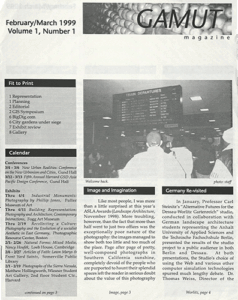
February/March 1999
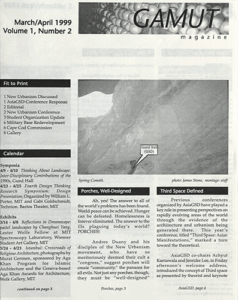
March/April 1999
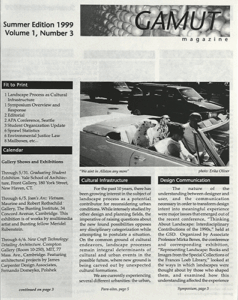
Summer 1999

Spring 2000

Spring 2001
GAMUT was a design student publication conceived, produced, and managed by students at the GSD. It appeared in two iterations: first, as a black and white folded and stapled newsletter edited by Andrew Gutterman; and later, as a square-format, two-color journal edited by Andrew Gutterman and Anand Krishnan. The initial version, comprising three issues, cast the GSD in a critical light, likening it to a prison where “the life of a prisoner lacks two key ingredients: instant gratification, and contact with a larger reality.”In contrast, Gamut positioned itself as a source of enjoyment for those living within the school’s walls. The second iteration, launched a year later, adopted a more optimistic tone. Its opening statement declared: “This first issue is about starting afresh; a new beginning,” and it featured short editorials and commentaries of a scale manageable for students. Yet the process of producing a printed publication inevitably raises the question of what kind of framework might enable a self-sustaining student journal. While talent abounds within the trays, the persistent challenge is the scarcity of time students can devote to such efforts.
The relaunch of Gamut in its second iteration offered a potential model for student publications: each issue to open with a concise three-column editorial, one authored by each editor, thereby ensuring a diversity of perspectives, followed by single-page essays. Contributions included Wilfried Wang’s reflections on the origins of 9H; Franziska Ullmann’s analysis of the differences between European and American educational frameworks; and a comparative discussion of the Berlage and the GSD, examining their respective public/private status, their ideology/market relationships, as well as the ways faculty operate within these structures. The structure of this second iteration established a clear rhythm. Each issue began with the three-part editorial, and followed by the Mirror section, which paired a portrait with a short text by a well-known figure (e.g., Harry Cobb, John Andrews). This was succeeded by a project drawn from the Trays; and concluded with a lighter segment entitled the Donut with portraits of students, faculty, and staff accompanied by single-sentence responses to a simple question. This playful approach to content gathering anticipated strategies later adopted by subsequent GSD student publications.

GSD STUDENT PUBLICATIONS
Frances Loeb Library
Curated by Ines Zalduendo, Special Collections Curator at the Frances Loeb Library, M.Arch ’95
Designed by Ashleigh Brady, Archival Collections Website Editor, M.Arch ’26
With collaboration from Priscilla Mariani, FLL Access Services Specialist
An Opinion on Architecture | Task: A Magazine for the Younger Generation in Architecture | Synthesis | Connection: Visual Arts at Harvard | for’m | The Harvard Architecture Review | re/alignment | APPENDX: Culture/Theory/Praxis | isthmus | Gamut | Trays: A Student Journal of the GSD | New Geographies | Platform | Harvard Real Estate Review | Open Letters | Very Vary Veri | MASKS, the Journal: Journal of the Dissimulation in Art | Process: Journal of the GSD Design Research Forum | OBL/QUE | WID Bibliography | Pairs | Translations