
The Harvard Architecture Review
Years: 1980-1988
Frequency: Irregular
Number of Issues: 10
Format: Published Print Journal
Click on the first cover to access the full issue on the Harvard Viewer.
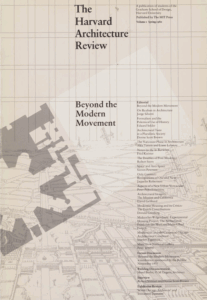
1980
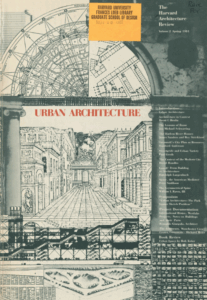
1981
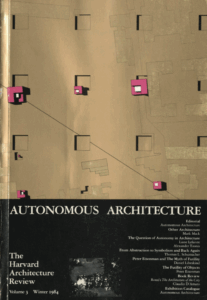
1984
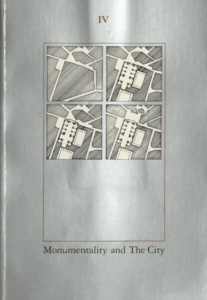
1984
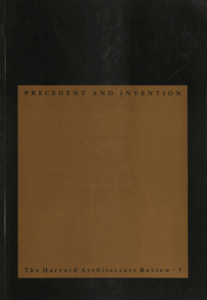
1986
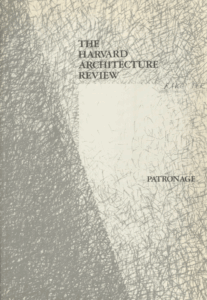
1987
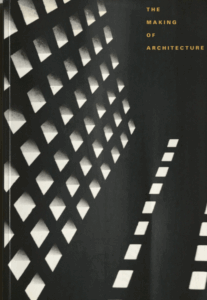
1989

1992
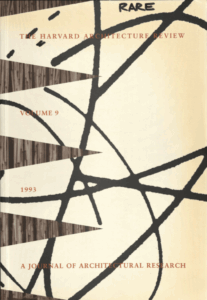
1993
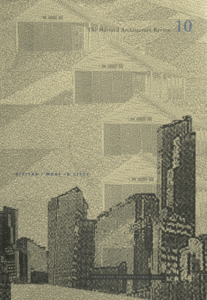
1998
THE HARVARD ARCHITECTURE REVIEW was a yearly, student-initiated and student-run publication, that appeared from 1980 to 1989. Guided by the interests of its rotating student editorial staff, each issue explored a single theme and featured contributions from both practicing architects and academics, anchored by a student-authored editorial. Their inaugural editorial declared: “Let us say only this: we are concerned with the role of ideas in architecture, and with their relationship to the art of building.” This journal aimed to bridge the gap between image-driven publications and those dominated by what it called the “verbal enigma.” Under the deanship of Gerald McCue and of Harry Cobb serving as chair of architecture, the Review reflected the ethos of thoughtful practicing architects who viewed design as a form of research and inquiry.
The Review was a topical publication, with each issue offering insight into a single subject, examined through essays, projects, and critical reflections that framed contemporary architectural discourse. 1: Beyond the Modern Movement; 2: Urban Architecture; 3: Autonomous Architecture; 4: Monumentality and the City; 5: Precedent and Invention; 6: Patronage; 7: The Making of Architecture; 8: [In Between: To and From Architecture]; 9: Toward a Journal of Architectural Research; 10:Civitas. What is City? Contributors were practicing architects or academics whose expertise illuminated the selected theme, presented in the form of scholarly essays rather than opinion pieces. At the same time, every issue featured a student-authored editorial and student-written abstracts for each essay, also written by the students, underscoring the publication’s participatory character. Contributors throughout the years included: Jorge Silvetti, Eduard Sekler, Denise Scott-Brown, Alex Tzonis, Fred Koetter, Stanley Tigerman, Stanford Anderson, Richard Meier, Peter Smithson, Christiane Collins, James Ackerman, Colin Rowe, Andrés Duany, Michael Hays, Manfredo Tafuri, Diane Ghirardo, George Baird, Rafael Moneo, Ann Bergren, Clive Dilnot, Wilfried Wang, Hashim Sarkis, Sheila Kennedy, Preston Scott Cohen, Linda Pollack, William Mitchell, and Steven Holl, among others.
The first issue, Beyond the Modern Movement, examined the modern movement —understood as revolutionary— in relation to the post-modern movement —framed as evolutionary. The editors reflected on a broader cultural trend that sought direction for the future by revisiting past processes and formal languages. Within this framework, the issue addressed key themes: history, cultural allusionism, anti-utopianism, contextualism, and formal concerns. The discussion of ideas in architecture found its clearest expression in the third issue, Autonomous Architecture, which examined the interrelationship between theory and practice. It highlighted the debate between neorealists —who combined historical references with pop culture— and neorationalists, who advocated for a renewed disciplinary independence. At its core, autonomous architecture was concerned with the essence of the field: with form rather than style, type rather than model, and syntax and language rather than semantics. Under this perspective the classical and the modern were understood not as opposites but as part of an ongoing, evolving process.
The fifth issue, Precedent and Invention, reflected on the results of a sponsored competition for a gate at the site of Harvard Yard and Quincy Street. The competition invited broad interpretations of context, encouraging participants to consider how themes of precedent and invention influence contemporary practice and shape architectural form and program. The final issue, under Peter Rowe’s deanship, asked What is City? It explored civitas as a concept beyond public and private space. It argued that building not be reduced to a transaction between state and civil society, but rather embody community-building and novel approaches to city-making. As the authors wrote: “the design disciplines reach beyond the physical to embrace the social and political aspects of practice.”

GSD STUDENT PUBLICATIONS
Frances Loeb Library
Curated by Ines Zalduendo, Special Collections Curator at the Frances Loeb Library, M.Arch ’95
Designed by Ashleigh Brady, Archival Collections Website Editor, M.Arch ’26
With collaboration from Priscilla Mariani, FLL Access Services Specialist
An Opinion on Architecture | Task: A Magazine for the Younger Generation in Architecture | Synthesis | Connection: Visual Arts at Harvard | for’m | The Harvard Architecture Review | re/alignment | APPENDX: Culture/Theory/Praxis | isthmus | Gamut | Trays: A Student Journal of the GSD | New Geographies | Platform | Harvard Real Estate Review | Open Letters | Very Vary Veri | MASKS, the Journal: Journal of the Dissimulation in Art | Process: Journal of the GSD Design Research Forum | OBL/QUE | WID Bibliography | Pairs | Translations