CIAM 1, La Sarraz. 1928
Text of the Declaration de La Sarraz, on oversized pink paper, signed by S. Giedion, together with typescript transcription.
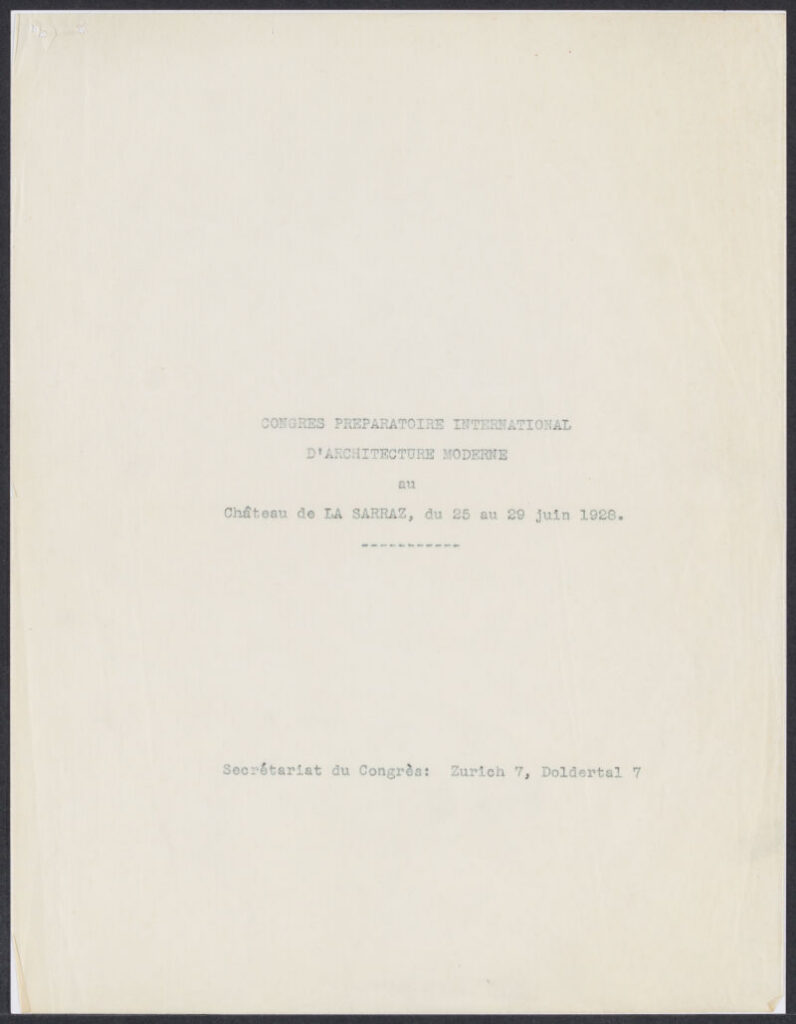
On June 28, 1928, a group including Hannes Meyer, Sigfried Giedion, André Lurçat, Josef Frank, and Le Corbusier prepared the draft of the Declaration of La Sarraz. That evening, a spontaneous costume party was held in honor of Madame de Mandrot. During the party, Hans Schmidt and Arnold Hoechel continued working on the document, editing the final version to reflect the debates that had taken place. It is not entirely possible to reconstruct exactly how the final text was produced, but it differed significantly from Le Corbusier’s original program. These changes appear to have been pushed by Schmidt, Meyer, and Lurçat.
One major point of discussion was the use of the term “urbanism.” Häring argued that the term would be difficult for the general public to understand, while Le Corbusier and Lurçat insisted that it remain in the French version. In the German version, the phrase “City and Regional Planning” was used instead. At the same time, the social beliefs of at least six of the most outspoken signers appear in the first sentence of the Urbanism section of the declaration.
This opening sentence seems connected to ideas from the Communist Manifesto, where Marx and Engels called for combining agriculture with industry and gradually removing the distinction between town and country through a more even distribution of population. The second point in the Urbanism section introduces the first statement of three ideas that would later become part of the four functions of urbanism. These were included at the insistence of Hannes Meyer. This moment marks the early appearance of the idea of the Functional City at the start of CIAM. By 1928, the elements of this idea were already an important part of international planning thought, especially in North America.

THE CIAM COLLECTION
Frances Loeb Library
Curated by Ines Zalduendo, Special Collections Curator at the Frances Loeb Library, M.Arch ’95.
Designed by Ashleigh Brady, Archival Collections Website Editor, M.Arch ’26.